I know a woman. She works at the hospital.
B1–B2 · 70-MINUTE SPEAKING CLASS
The person
The person
who…
The place where…
Describe people, things, and places with the extra information that makes them clear.
Today's goalI know a developer who fixed the problem.
9 parts · 70 minutes · speak first, then check

Describe it without its name
Read a clue, guess the answer, then create one clue of your own.
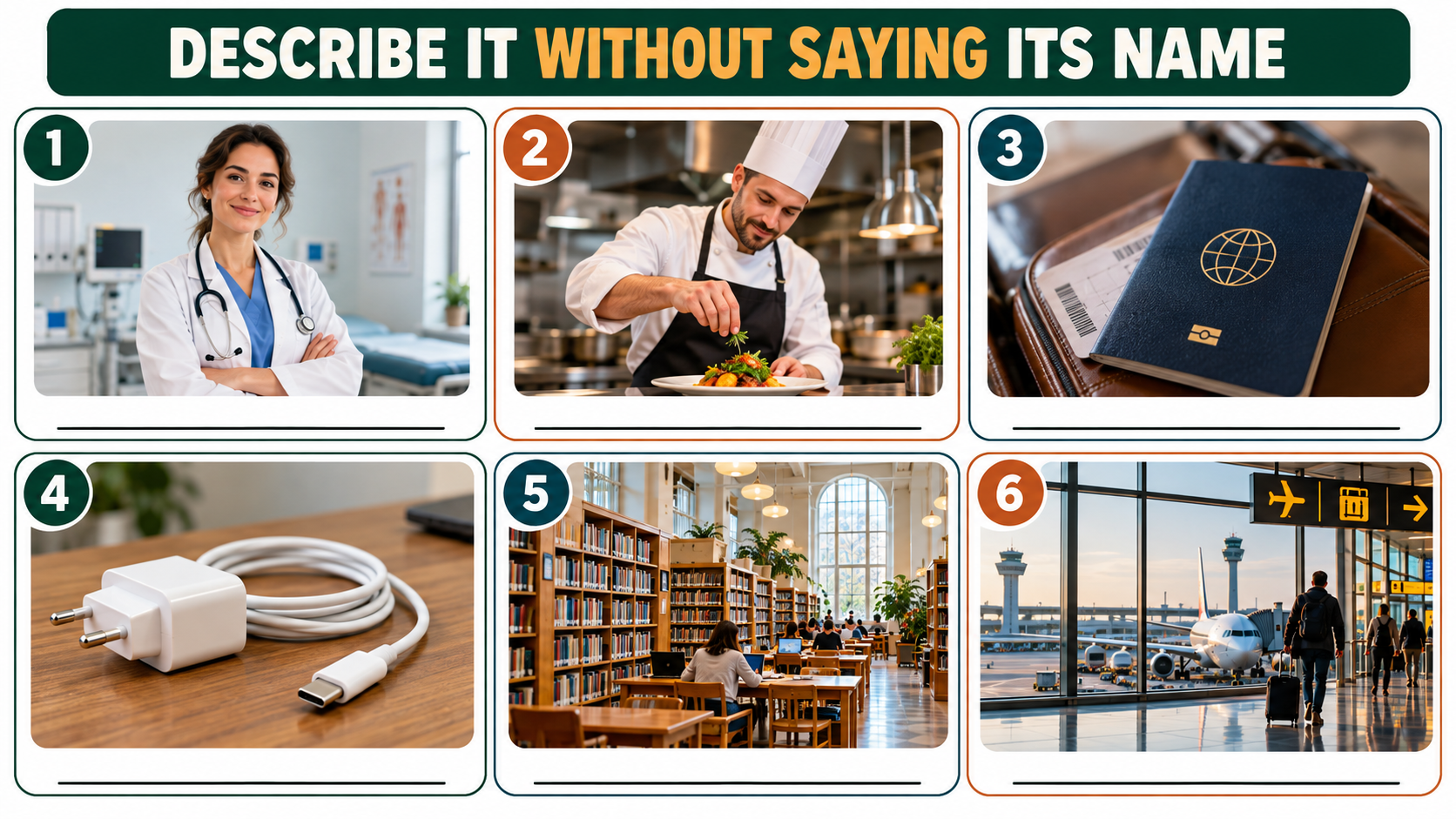
1 · A person who helps sick people
A doctor.2 · A person who prepares food in a restaurant
A chef.3 · A document that you need to travel internationally
A passport.4 · A thing that gives your phone more power
A charger.5 · A place where you can borrow books
A library.6 · A place where planes arrive and depart
An airport.Your turn: make three clues without naming the answer: one person, one object, and one place. Start with a person who… · a thing that… · a place where…
Add information to a noun
A relative clause helps identify a person, thing, or place without repeating a short sentence.
I know a woman who works at the hospital.
Basic patternNOUN+RELATIVE WORD+EXTRA INFORMATION
The woman who called me is my manager.
The phone which I bought is already broken.
The laptop that I bought is very fast.
This is the café where we met.
I know a developer whose application became popular. Whose shows possession. Who’s means who is or who has.
Natural choicesFor people, who is usually most natural. For things in defining clauses, which and that are both common. Use that only when the information identifies the noun.
People, things, and places
Describe what you see. Add a relative clause to make each description more specific.
What does the doctor do? What qualities should a doctor have? Describe another person who helps people.
What happened to the phone? Do you own anything that needs to be repaired? What device makes your work easier?
What do people do there? Describe a place where you like to relax or work quietly.
Extend it · My neighborhood

The bakery
Marta is the baker who works at the bakery. The bakery is a place where people buy fresh bread. The bread that Marta sells looks delicious.
The park
Sara is the woman who is walking three dogs. The park is a place where people exercise and relax. The dogs that Sara is walking look friendly.
The phone-repair shop
Leo is the technician who repairs phones. The phone that he is repairing has a cracked screen. The shop is the place where people take damaged phones.
The café
The café is the place where the women are celebrating. The cake that they ordered is on the table. The woman who is wearing orange is celebrating her birthday.
Choose a word, join the ideas
Complete the sentences before opening the answers. Some defining clauses have two possible answers.
A · who, which, that, where, or whose?
- The woman ______ lives next door is a nurse.
- This is the restaurant ______ we celebrated my birthday.
- The laptop ______ I bought last year still works perfectly.
- The person ______ answered the phone was helpful.
- I need an application ______ can organize my schedule.
- That’s the hotel ______ we stayed during our vacation.
- The man ______ repaired my car is my neighbor.
- The book ______ you recommended was excellent.
- This is the park ______ I usually walk my dog.
- The developer ______ created the feature works remotely.
- The company ______ website was redesigned is hiring.
- The client ______ we spoke to accepted the proposal.
Check Exercise A
1 who/that · 2 where · 3 which/that · 4 who/that · 5 which/that · 6 where · 7 who/that · 8 which/that · 9 where · 10 who/that · 11 whose · 12 who/that (also whom in formal English)
B · Join the two sentences
- I have a friend. He works at the airport.
- I bought a jacket. It is completely waterproof.
- We visited a restaurant. My parents met there.
- She spoke to a technician. The technician repaired her computer.
- They use a platform. The platform stores customer information.
- This is the apartment. I lived there for five years.
- The client requested a feature. The feature is difficult to develop.
- We hired a designer. Her previous projects were excellent.
Show possible answers
- I have a friend who works at the airport.
- I bought a jacket which/that is completely waterproof.
- We visited the restaurant where my parents met.
- She spoke to the technician who repaired her computer.
- They use a platform which/that stores customer information.
- This is the apartment where I lived for five years.
- The feature which/that the client requested is difficult to develop.
- We hired a designer whose previous projects were excellent.
Speaking extension: choose four sentences and add a second detail. I have a friend who works at the airport. He helps passengers who have lost their luggage.
Necessary information or extra?
The meaning decides whether the clause needs commas.
The woman who works at the bakery is my sister.
Which woman? This information is necessary. No commas. In defining clauses, that is possible and an object relative word can sometimes be omitted.My sister, who works at the bakery, lives near me.
We already know who “my sister” is. Her job is extra information. Use commas. Do not use that or omit the relative word.My brothers who live in Santa Cruz are married.Only the brothers who live in Santa Cruz are married; there may be other brothers.
My brothers, who live in Santa Cruz, are married.All my brothers live in Santa Cruz, and all are married.
Add commas where they are needed
- My friend Daniel who lives in Canada is visiting Bolivia.
- The woman who works at the front desk helped me.
- My phone which I bought last month has stopped working.
- The phone that is on the table belongs to Leo.
- New York where my sister lives is extremely expensive.
- The café where we met has closed permanently.
Check the punctuation
- My friend Daniel, who lives in Canada, is visiting Bolivia.
- The woman who works at the front desk helped me.
- My phone, which I bought last month, has stopped working.
- The phone that is on the table belongs to Leo.
- New York, where my sister lives, is extremely expensive.
- The café where we met has closed permanently.
Can you leave the word out?
Check who performs the verb inside the relative clause.
The woman who called me is my manager.
Who called. It does the action, so it must stay.✕ The woman called me is my manager.
The woman who I called is my manager.
I called her. In a defining clause, the object word can stay or be omitted.✓ The woman I called is my manager.
Quick test
Look right after who / which / that:
A verb comes next → the relative word is the subject; keep it.Another subject comes next → it is the object; in a defining clause, you may omit it.
Where needs special care: This is the hotel where we stayed or the hotel we stayed at. Not “the hotel we stayed.”
Decide: keep or omit?
- The woman who lives next door is a doctor.
- The woman who I called is a doctor.
- The book that changed my life was a gift.
- The book that I bought was expensive.
- The developer who fixed the bug is on vacation.
- The developer who we hired starts tomorrow.
- The application which stores the data is secure.
- The application which we use is secure.
Check your choices
- Keep — who does the action lives.
- May omit — I does the action called.
- Keep — that does the action changed.
- May omit — I does the action bought.
- Keep — who does the action fixed.
- May omit — we does the action hired.
- Keep — which does the action stores.
- May omit — we does the action use.
The airport mystery
Daniel cannot find some of his belongings. Describe the scene and ask what happened.

- Who is Daniel? Who is Emma?
- Which suitcase is Daniel looking for?
- What is happening at Gate 12?
- What is the security officer examining?
- Where is the red passport? Who may have left it there?
- What should Daniel do next?
Open model descriptions
- Daniel is the traveler who is looking for his suitcase.
- Emma is the employee who is helping him.
- The blue suitcase is the one that Daniel is trying to find.
- Gate 12 is the place where passengers are waiting.
- The flight that leaves from Gate 12 has been delayed.
- The officer is examining a backpack that may belong to another passenger.
- The café is the place where someone left a passport. The passport that is on the chair may belong to Daniel.
Role-play · lost luggage
Teacher: airport employee Santiago: passenger
Describe the suitcase, the person who last saw it, the gate where you were waiting, the café where you had breakfast, the employee who helped you, and the passport that someone found.
I'm looking for a suitcase that…The employee who helped me said…I was waiting at the gate where…The passport that you found…
Introduce the project team
Santiago is the project representative. Introduce the team to a new client; answer every question with a relative clause.

The designer who created the interface.
The developer who is fixing the bugs.
The manager who communicates with the client.
The tester who checks the mobile application.
The prototype that Maya is presenting is on the screen.
The code that Leo is reviewing contains an error.
The meeting room is the place where the team presents projects.
The application that Omar is testing is almost ready.
Client questions · take turns
- Who is responsible for the design?
- Who should I contact about technical problems?
- Which application are you developing?
- Where do you normally present the project?
- Which feature did users request?
- Who tests the application?
- Is there anyone whose work still needs approval?
- Which part of the project is already finished?
See model answers
Maya is the designer who is responsible for the interface. · Leo is the developer who can help with technical problems. · We're developing an application that helps users organize their finances. · The meeting room is the place where we present the project. · We're building the feature that users requested. · Omar is the tester who checks the application. · Maya is the designer whose interface needs client approval. · The prototype that Maya is presenting is finished.
Don't say its name
Pick a card and describe the answer. Your clue must include a relative clause, have at least eight words, add one detail, and never say the answer.
Second round: create clues for a teacher, mechanic, coworker, laptop, password, supermarket, hotel, and website.
Correct the mistakes
- The woman which helped me was friendly.
- This is the café which we met.
- My brother, that lives in Chile, is visiting me.
- The laptop who I bought is already broken.
- The man works at the bank is my neighbor.
- This is the hotel where we visited.
- The developer which fixed the error works remotely.
- My phone, that I bought last month, has stopped working.
- The person who I spoke was helpful.
- I know a woman who her daughter is a doctor.
- This is the place what I told you about.
- The application where we created is ready.
Show corrections
- The woman who/that helped me was friendly.
- This is the café where we met.
- My brother, who lives in Chile, is visiting me.
- The laptop which/that I bought is already broken.
- The man who/that works at the bank is my neighbor.
- This is the hotel which/that we visited.
- The developer who/that fixed the error works remotely.
- My phone, which I bought last month, has stopped working.
- The person who I spoke to was helpful.
- I know a woman whose daughter is a doctor.
- This is the place that/which I told you about.
- The application which/that we created is ready.
Exit ticket · answer aloud
A doctor is someone who… · A laptop is something that… · A library is a place where… · I know someone whose… · The developer who called me… · The developer I called… · My phone, which… · La Paz, where…
Six fast concept checks
Can who describe a laptop? No. Can that describe a person in a defining clause? Yes. Can that follow a comma? No. Can you remove the relative word when it does the action? No. Can you sometimes remove it when another subject does the action? Yes, in a defining clause. Does where mean in/at that place? Yes.
Homework · People, Things and Places in My Life
Write 150–180 words about two important people, two objects you use regularly, and two places you often visit.
Include: two clauses with who, two with which, two with that, two with where, one with whose, one defining clause, two non-defining clauses with commas, one relative word that could be omitted, one work example, and one real-life example.
Start: I have a friend who always helps me when I have a problem. He works in an office that is near my home. My laptop, which I bought two years ago, is the object that I use most frequently. There is also a café where…