A1+ · PERFECT TENSE CHALLENGE
Past or
present?
Review two perfect tenses and choose the right one by finding the point of view first.
Present Perfect · past → connected to nowPast Perfect · earlier past → later past
PAST SIMPLEUse it for a finished past action or a specific finished time.
Make your first decision
Read the situation. Choose a sentence before you look at the explanation.
You are talking about last Sunday.
Dinner was ready before the guests arrived.
Notice: A present result points to now. “Last Sunday” is a finished time. Dinner was ready before another past event.
Find the reference point
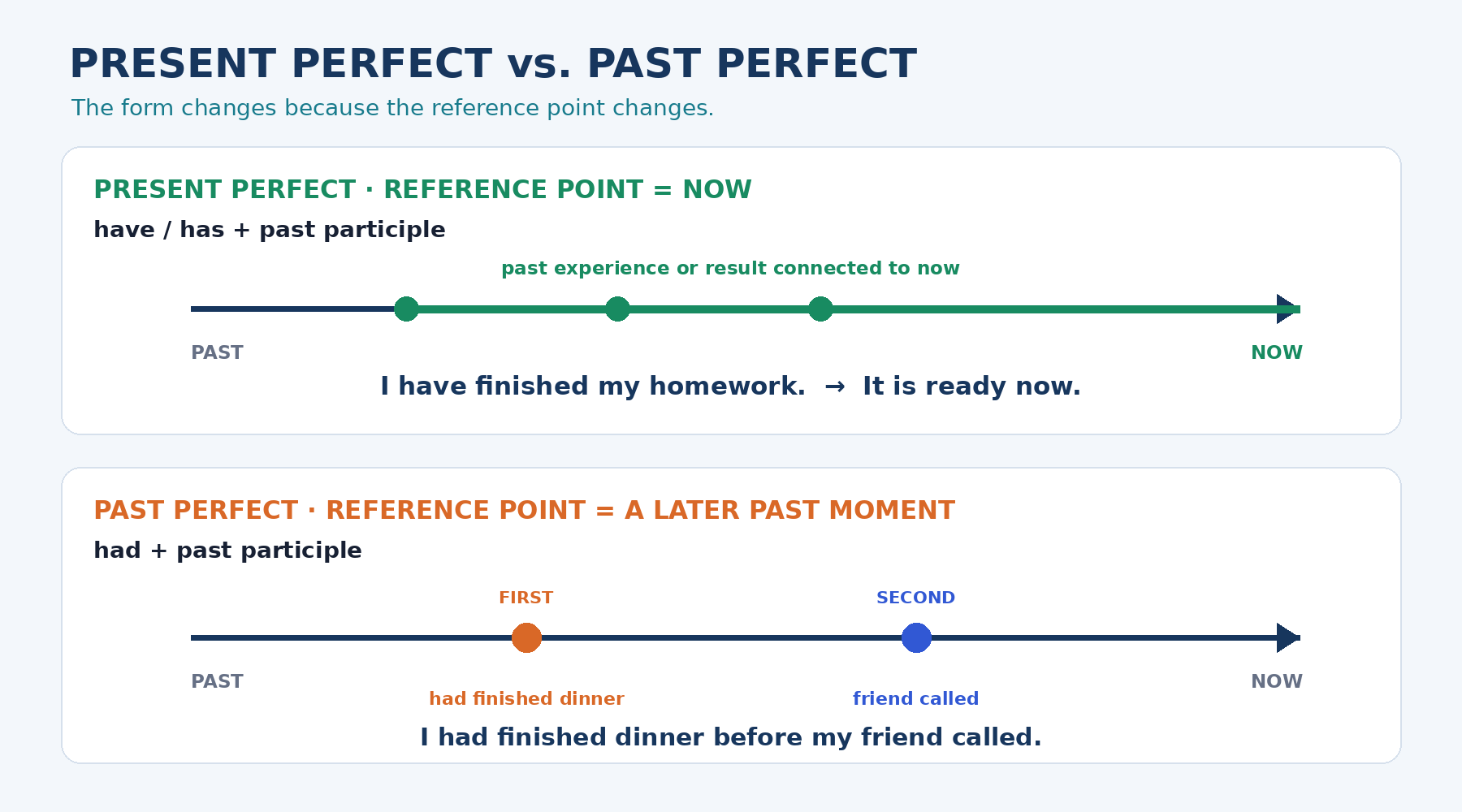
Both perfect tenses talk about an earlier action. The difference is the point of view.
Present Perfect
I have lost my keys.
I lost them before now. I don’t have them now.
PASTlost keys ━━━━━━━━━━━━━━━● NOW
Past Perfect
I had lost my keys, so I couldn’t open the door.
I lost them before I arrived at the door. The first event explains the later past problem.
PASTlost keys ━●━━━━ arrived ━●━━ NOW
Past Simple
I lost my keys yesterday.
“Yesterday” tells us when the finished action happened.
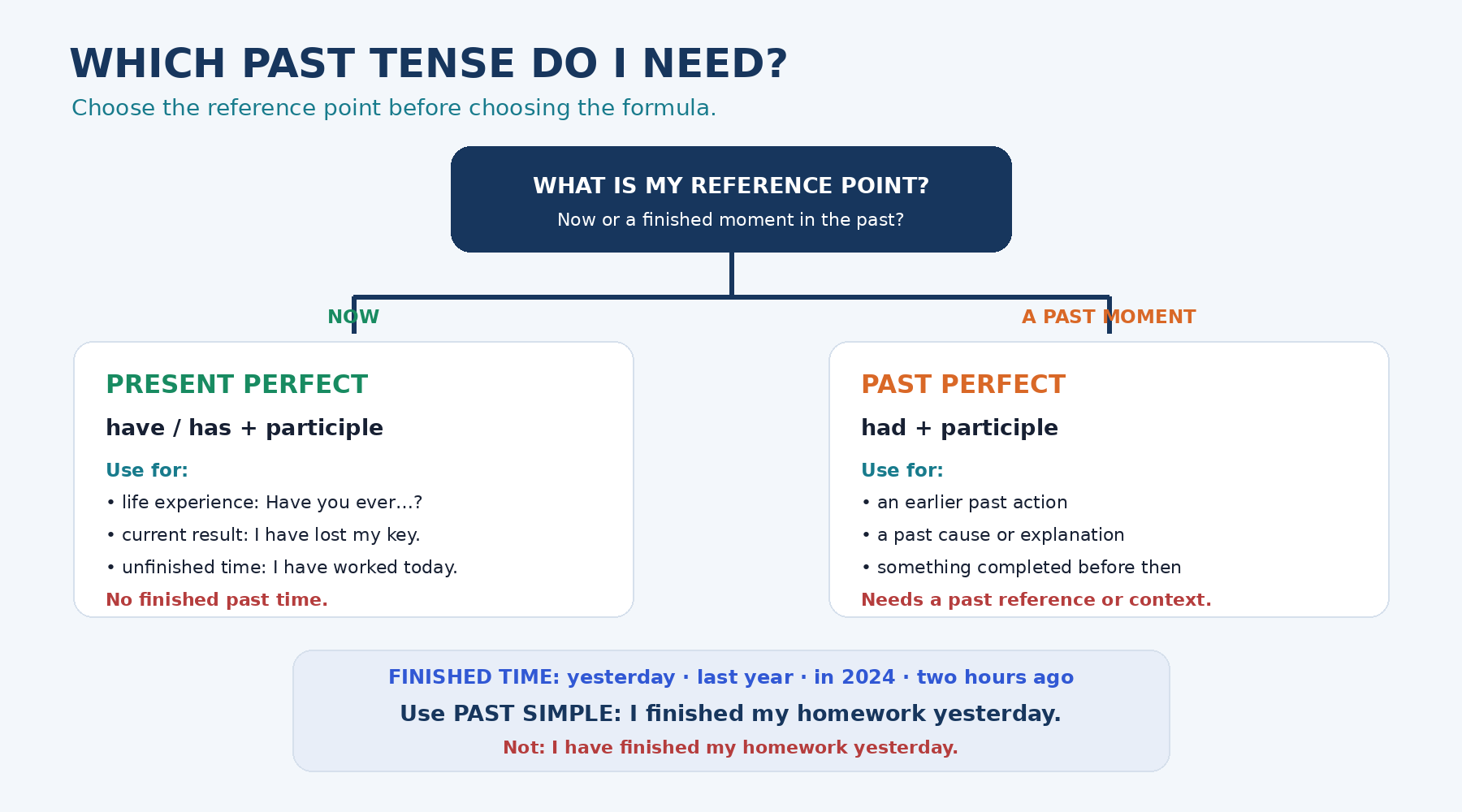
Quick memory rulePresent Perfect: before now, connected to now.Past Perfect: before another moment in the past.Past Simple: a finished past action or time.
Present Perfect: past → now
The action happened before now, and the experience, result, or situation matters now.
PRESENT PERFECT
subject + have / has + past participle (V3)
Affirmative
subject + have / has + V3
I have visited Mexico City.She has finished her homework.Negative
subject + haven’t / hasn’t + V3
I haven’t visited Mexico City.She hasn’t finished yet.Question
Have / Has + subject + V3?
Have you ever tried sushi?Has she called yet?Short: Yes, I have. · No, she hasn’t.Have you ever traveled alone?
I have never traveled alone.
She has lost her phone.
Now, she doesn’t have it.
I have just arrived.
Have you finished yet?
We have already eaten.
For or since? for + a period: for five yearssince + a starting point: since 2021I have lived here for five years / since 2021. (I still live here.)
QUICK CHECK
Complete: We ______ lived here since 2021. (have / had)
We have lived here since 2021. The situation continues to now.
Past Perfect: earlier past → later past
Use this tense when you want to show that one action was already complete before a later past moment.
PAST PERFECT
subject + had + past participle (V3)
“Had” is the same with I, you, he, she, we, and they.Affirmative
subject + had + V3
They had eaten before we arrived.Negative
subject + hadn’t + V3
He hadn’t saved his work.Question
Had + subject + V3?
Had you eaten before the movie?Short: Yes, I had. · No, I hadn’t.FIRST · PAST PERFECT
The movie had started
SECOND · PAST SIMPLE
we arrived
The movie had started before we arrived.
Common connectorsbefore The plane had left before we arrived.when When I arrived, they had already eaten.by the time By the time police arrived, the thief had escaped.after After I had finished, I washed the dishes.
Important: Don’t use Past Perfect for every past event. Use Past Simple for the later event, and use Past Perfect to make the earlier event clear when the order matters.
Choose the tense
Complete each sentence. Use Present Perfect, Past Perfect, or Past Simple.
First ask: Is the reference point now, another past moment, or a finished past time?
1
We ______ to Oaxaca last year. (go)
2
She ______ her phone, so she can’t call us. (lose)
3
Ana couldn’t enter because she ______ her keys. (lose)
4
He ______ the email two hours ago. (send)
5
Before she went to Canada, she ______ never ______. (fly)
6
They ______ here since 2020, and they still live here. (live)
7
When we arrived, the restaurant ______. (close)
8
“Have you ever seen snow?” “Yes. I ______ it in 2024.” (see)
Choose an answer in each row to get feedback.
One trip, three tenses
Read for the timeline. Which sentences connect to now? Which event happened first?
LAURA'S FIRST SOLO TRIP
Laura has traveled to several places with her family, but until last month she had never traveled alone. Last month, she traveled to Guadalajara for a friend’s wedding. Before the trip, she had bought her ticket, had reserved a room, and had packed her suitcase. When she arrived at the airport, she realized she had left her passport at home. Luckily, her flight was delayed. Her brother brought the passport, and Laura caught the flight. Since then, she has felt more confident. She has already planned another trip, but she hasn’t bought the ticket yet.
Present Perfect · connected to nowPast Perfect · before a past momentPast Simple · finished past event
Check what you understood
- Had Laura traveled alone before last month?
- What had she prepared before the trip?
- What had she left at home?
- Why could she still catch the flight?
- How has she felt since the trip?
- No, she hadn’t.
- She had bought her ticket, reserved a room, and packed her suitcase.
- She had left her passport at home.
- Her flight was delayed, and her brother brought the passport.
- She has felt more confident.
Tell what had happened
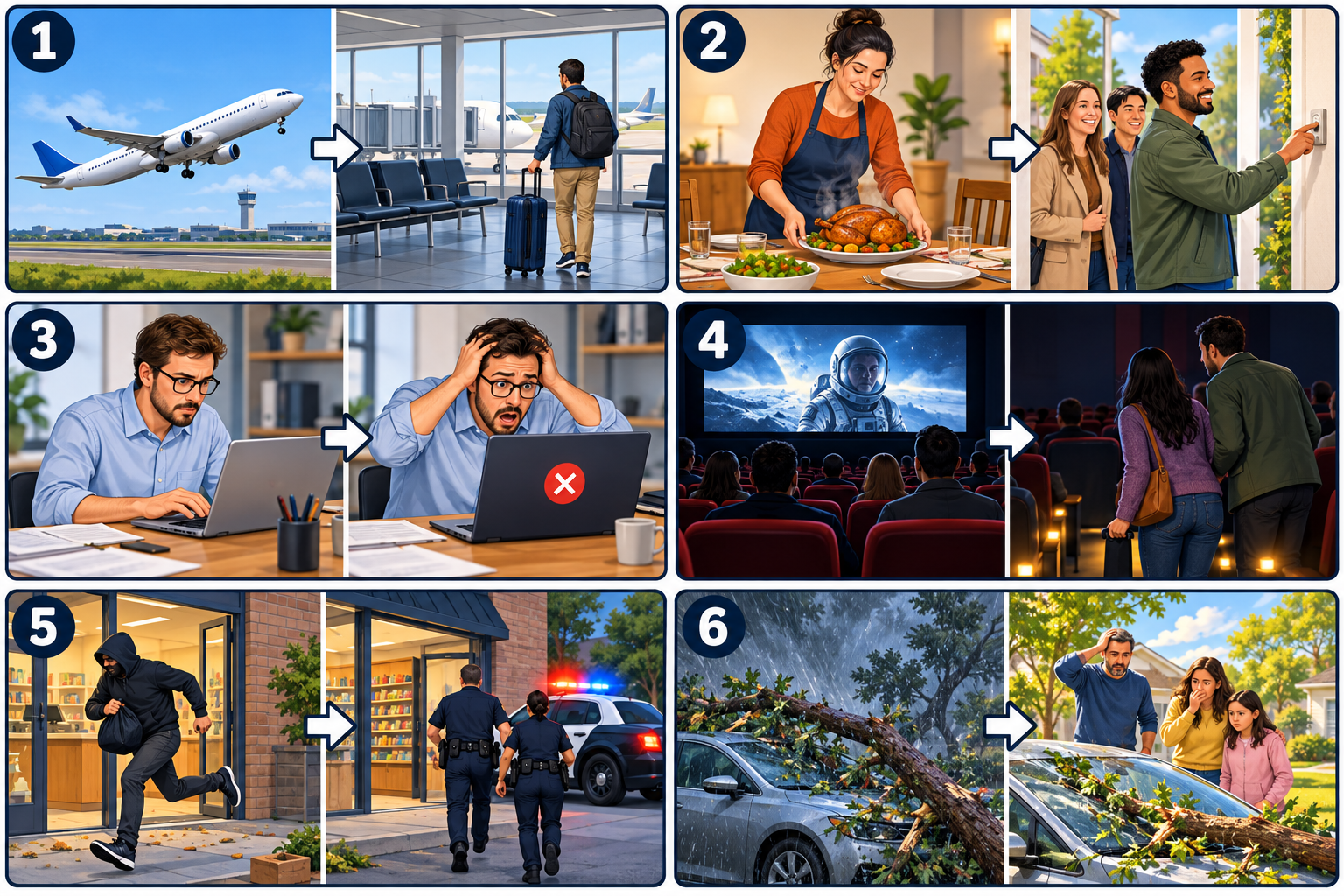
Choose any three scenes. For each one, name the earlier action, the later event, and the result.
Use this 3-step speaking frame
1 · Earlier action: The plane had left ...2 · Later event: ... before Sofia arrived.3 · Result or feeling: She missed her flight.
- Airport: The plane had left before the traveler arrived, so he missed his flight.
- Dinner: The woman had prepared dinner before the guests arrived.
- Computer: He was upset because he hadn’t saved his work before the computer crashed.
- Cinema: The movie had already started when the couple entered.
- Store: The thief had escaped before the police arrived.
- Storm: The storm had damaged the car before the family came outside.
Your story across three time points
Choose one topic: travel, food, a lost object, a film, or learning English. Build a short story.
Present Perfect
Have you ever…? / I have… / I haven’t… yet.
Example: I have traveled to another city.
Past Simple
Say when, where, and what happened.
Example: I went there last year.
Past Perfect + Past Simple
Join an earlier action to a later past event.
Example: I had booked the hotel before I arrived.
Have you ever traveled alone? I have traveled alone once. I went to Lima last year to visit a friend. Before I left, I had checked my passport and booked a room. When I arrived, my friend had already sent me the address, so I found the apartment easily. Since that trip, I have felt more confident.
Partner / teacher promptsAsk one “Have you ever…?” question.Ask a Past Simple follow-up: “When did you…?”Ask what happened before a past moment: “Had you… before…?”
Exit check: explain your choice
Answer without looking back. Then check the key.
“I ______ my homework, so it’s ready now.” (finish)
have finished — the finished work has a result now.
“The guests arrived after we ______ dinner.” (prepare)
had prepared — dinner was ready before another past event.
“I ______ my grandmother last weekend.” (visit)
visited — last weekend is a finished past time.
Before you choose, find your reference point:
NOW → have / has + V3LATER PAST → had + V3FINISHED TIME → Past Simple
Good work.
You can now connect a past action to now, place an action before a past moment, and use Past Simple for finished past time.